Southern Electric Is The Carolina's Most Trusted Residential Electrical Service Provider. Call Us Today: (803) 250-1449

Landscape Lighting in Tega Cay: Making Your Outdoor Space Work After Sunset
Blog post description.
Southern Electric
7/6/20263 min read
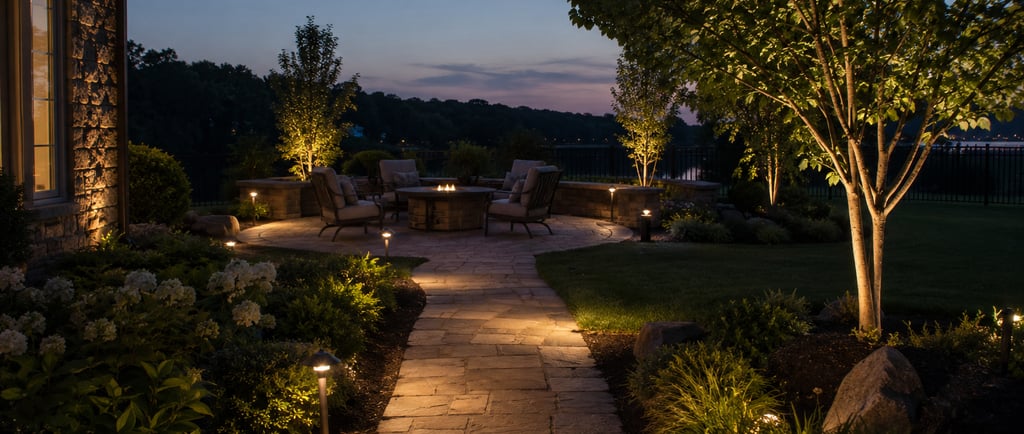
There is something about a Tega Cay evening that makes you want to stay outside. The lake is close, the humidity drops after dark, and if your yard is set up right, there is no reason to go back inside. Good landscape lighting is a big part of that. Not the flood-everything-in-white kind, but the kind that highlights the right trees, lines a path without blinding, and makes the patio look like it belongs in a magazine spread.
We have done many outdoor lighting jobs on the Tega Cay peninsula, and we consistently find homeowners have a vision but are unsure what it takes electrically. Let's walk through that part.
Low Voltage vs. Line Voltage Outdoor Lighting
Most residential landscape lighting systems today are low voltage, 12-volt systems powered by a transformer that plugs into or hardwires to a standard 120-volt outlet. They are safe, easy to expand, and energy-efficient with LED fixtures. The fixtures stake into the ground or mount on structures, and the wire runs just below the soil surface.
Line voltage (120-volt) outdoor lighting is used in specific situations: hardwired post lights, outdoor wall sconces, under-soffit lights, and any fixture needing a switched circuit tied to the home's main wiring. A well-designed landscape lighting plan typically uses both. Low voltage for beds, paths, and accent trees; line voltage for functional lights at the house, like fixtures above the garage door or sconces flanking the back porch.
At Southern Electric, we handle both types. The line-voltage work requires a licensed electrician, and we bring that same care to the low-voltage layout, ensuring the whole system is designed thoughtfully rather than as an afterthought.
What to Light and What to Leave Dark
This is where many DIY landscape lighting jobs go sideways. People light everything, and the result looks like an airport runway rather than a welcoming outdoor space. In our experience, restraint separates a good outdoor lighting design from a mediocre one.
Trees and Anchor Plants
Uplighting a specimen tree, like an oak, crepe myrtle, or magnolia, creates dramatic depth and gives the eye somewhere to land. You do not need to uplight every tree. Pick one or two that anchor the space and let the others stay in shadow. The contrast is the point.
Paths and Steps
Path lights serve a functional purpose but work best when not the focal point. Low, warm path lights spaced every 8 to 10 feet along a walkway do the job without competing with accent lighting. Steps need lighting if part of a regular evening path, and we always ensure steps get a recessed step light or a nearby path light at the right angle.
Lakefront and Dock Areas
Tega Cay homeowners with lakefront property or dock access near Lake Wylie have a real opportunity with outdoor lighting. Uplighting the trees nearest the water, adding low dock lighting for evening use, and illuminating an outdoor dining area near the water creates a layered look that reads beautifully at night. We follow Lake Wylie and HOA guidelines on dock and shoreline lighting, which vary by property.
The Electrical Work Behind It All
For line-voltage outdoor fixtures, we run conduit or direct-burial cable from the panel to weatherproof junction boxes at each fixture location. Outdoor circuits require GFCI protection, and every outdoor receptacle and fixture circuit must be protected. In wet or exposed locations, we use in-use covers on any receptacles.
For low-voltage systems, the transformer is critical. It must be sized for the total wattage of the fixtures. A common mistake is overloading a small transformer and wondering why fixtures are dim. We run wiring cleanly and bury it at the proper depth. On many jobs where we take over existing systems, we find wiring laid on top of the soil, corroded connectors, and undersized transformers from the start. Doing it right the first time means fewer service calls later.
Warm White vs. Cool White
Outdoor landscape lighting almost always looks better in warm white, with color temperatures around 2700K to 3000K. Cool white (4000K and above) tends to look harsh in residential outdoor settings. We have seen many jobs where homeowners bought mixed fixtures with different color temperatures and ended up with a yard that looks inconsistent. When we spec fixtures, we match color temperature across the whole system.
Timers and Seasonal Adjustments
A good transformer has a timer, a photocell, or both, so your lights come on automatically at dusk and turn off at a set hour. In the longer summer evenings around Tega Cay and Fort Mill, you will want to adjust the timer so lights do not activate at 6 PM when the sun is still up. We set everything during installation and show homeowners how to adjust it as the seasons change.
If you have been putting off landscape lighting because it felt complicated, that is exactly the kind of conversation we enjoy having. We work all around Tega Cay, Fort Mill, Indian Land, and the Lake Wylie corridor. Come evening, your yard should be as good as your daytime view.
Give us a call at (803) 250-1449, and we will walk the yard with you.
Contact Us
info@southernelectricllc.com
(803) 250-1449
Service Areas
Subscribe to our newsletter
Fort Mill, SC
Tega Cay, SC
Indian Land, SC
Charlotte, NC
Rock Hill, SC